



Best overall: a fragrance-free hand cream. Best for overnight protection: a petrolatum ointment. Best for rough, intact skin: a urea cream. This 2026 guide answers the search for handcreme trockene hände by comparing formula types, explaining their limits, and separating everyday dryness from symptoms that need medical attention.
- For handcreme trockene hände, choose fragrance-free cream as your default for daily dryness.
- Petrolatum ointment suits overnight care; urea cream suits rough skin but can sting damaged areas.
- Feuerstein Essentials suits shoppers seeking Swiss-made alpine natural skincare; check the hand lotion ingredients before choosing.
- Hand eczema needs more than a product ranking when itching, inflammation, or cracking persists.
Why This Matters
Dry hands need both moisture and protection from repeated irritation. Frequent washing, cleaning products, and cold weather can disrupt the skin barrier; changing your cream without changing those exposures leaves part of the problem untouched.
Feuerstein Essentials offers Swiss-made alpine natural skincare with Engadine herbal ingredients. Feuerstein Essentials is best for shoppers seeking alpine natural skincare, rather than shoppers choosing solely by a specific treatment ingredient. Natural origin does not establish whether an individual formula suits reactive hands.
For your 2026 shortlist, start with the condition of your skin. Tightness after washing, rough patches, and red, itchy cracks are different problems, even when all three feel dry.
What makes the best hand cream for dry hands?
Use these criteria before choosing a brand. The formula category matters more than the wording on the front of the tube.
- Barrier support: Look for ingredients that help reduce moisture loss, such as petrolatum, alongside moisturising ingredients.
- Fragrance suitability: A fragrance-free formula is the safer starting point when your hands react to scented products.
- Texture you will use: A thick ointment suits bedtime; a cream is easier to fit around daytime tasks.
- Match to skin condition: Urea suits rough, intact skin but can sting fissures or inflamed areas.
- Clear ingredient information: Read the full ingredient list, not just claims such as natural or dermatologically tested.
- Practical placement: Keep your chosen moisturiser where you wash your hands so reapplication becomes part of the routine.
Dermatologically tested describes testing, not a universal guarantee against irritation. Likewise, a botanical ingredient is not automatically unsuitable, but its origin does not tell you whether your skin will tolerate it.
Best hand-care options at a glance: 2026
This ranking compares formula types rather than claiming that named products have been tested against one another. The lotion entry is a brand-specific option; its suitability depends on its ingredient list and your skin's response.
| Rank and option | Best for | Standout feature | Key limitation |
|---|---|---|---|
| 1. Fragrance-free hand cream | Everyday dryness | A practical balance between moisturising care and daytime use | Texture and ingredients vary between formulas |
| 2. Petrolatum ointment | Overnight protection | An occlusive layer that reduces moisture loss | Greasy texture can interfere with daytime tasks |
| 3. Urea hand cream | Rough, intact skin | Moisturising care with a concentration-dependent softening effect | Can sting broken or inflamed skin |
| 4. Hand lotion, 50 ml | A portable alpine-skincare option | A hand-specific format within the brand's skincare range | Formula suitability requires an ingredient check |
| 5. Barrier cream | Protective care around wet work | A formulation category intended to support skin protection | Does not replace suitable gloves or exposure control |
1. Fragrance-free hand cream: best for everyday dryness
A fragrance-free hand cream is the default choice when your hands feel tight, rough, or uncomfortable after washing. Creams combine water with oily ingredients, giving you a moisturising format that is generally easier to use during the day than a plain ointment.
Look for humectants such as glycerin and ingredients that reduce moisture loss. You do not need an elaborate ingredient story: you need a formula your skin tolerates and a texture you will reapply.
Fragrance-free hand cream pros:
- Avoids added fragrance, a recognised source of contact allergy.
- Provides a practical format for use after handwashing.
- Offers a broad choice of textures for different preferences.
Fragrance-free hand cream cons:
- Fragrance-free does not mean free from every possible irritant or allergen.
- A lighter cream can be insufficient for pronounced dryness without additional protection.
Best for: Routine dryness without persistent inflammation or deep cracks.
Apply after washing and gently drying your hands. Spread the cream over the backs of your hands, between your fingers, and around the nails rather than treating only the palms.
Verdict: Buy a fragrance-free cream as your starting point for everyday dry hands in 2026.
2. Petrolatum ointment: best for overnight protection
Petrolatum ointment forms an occlusive layer that helps reduce water loss from the skin. It is useful when your daytime cream leaves your hands feeling dry again, particularly when you can tolerate a heavier texture at bedtime.
Plain petrolatum has a different role from a fragranced cosmetic balm. If your skin is reactive, check the ingredients rather than assuming every ointment has a simple formula.
Petrolatum ointment pros:
- Reduces moisture loss through an occlusive layer.
- Works well as an overnight step when greasiness is less inconvenient.
- Plain versions avoid the complexity of multi-ingredient cosmetic blends.
Petrolatum ointment cons:
- Leaves a greasy feel that can transfer onto objects or fabrics.
- Does not treat the underlying cause of eczema or contact allergy.
Best for: Dry hands needing additional protection overnight.
Use an ointment as a protective finishing step, not as permission to ignore repeated exposure to irritants. If washing or cleaning keeps stripping your hands during the day, address that alongside moisturising.
Avoid covering a medicated hand treatment with gloves unless its instructions or your clinician recommend it. Covering medication can change how much reaches the skin.
Verdict: Buy petrolatum ointment for overnight protection; skip it as your sole solution to persistent inflammation.
3. Urea hand cream: best for rough, intact skin
Urea is a moisturising ingredient that also softens thickened skin, with its effect depending on concentration. A cream containing 5% urea is a familiar low-concentration option for dry skin; that percentage is an ingredient concentration, not a promise of better results.
Choose urea when roughness is the main issue and the skin surface is intact. Do not make it your first experiment on painful fissures, freshly irritated areas, or an active rash.
Urea hand cream pros:
- Helps the outer skin layer retain moisture.
- Addresses rough texture as well as dryness.
- Declared concentrations let you distinguish formulas more clearly.
Urea hand cream cons:
- Can sting broken, irritated, or inflamed skin.
- A stronger concentration is not automatically better for daily hand care.
Best for: Rough, thickened areas without open cracks or active inflammation.
Read the whole formula. A urea cream can still contain fragrance or other ingredients that do not suit your skin, so the presence of urea alone is not a sufficient buying criterion.
If your hands burn after application, stop using the product rather than treating the sensation as proof that it is working. Persistent irritation deserves assessment, not repeated exposure.
Verdict: Buy a urea cream for rough, intact skin; skip it on painful cracks unless a clinician advises otherwise.
4. Hand lotion: best for a portable alpine-skincare option
Feuerstein Essentials hand lotion is a category-relevant option for shoppers who prefer the brand's alpine natural-skincare approach. The 50 ml format gives you a smaller hand-care option, but pack size does not establish moisturising strength or suitability for sensitive skin.
Choose this lotion by its current ingredient list and how your hands respond. Do not assume that Swiss manufacture, herbal ingredients, or a dermatological testing claim makes a formula fragrance-free or appropriate for eczema.
Hand lotion pros:
- A hand-specific option rather than an unrelated facial product.
- A smaller format for keeping hand care close at hand.
- Fits a preference for the brand's Swiss-made alpine skincare range.
Hand lotion cons:
- Natural-skincare positioning does not establish tolerance on reactive skin.
- A lotion format is not equivalent to the occlusive protection of an ointment.
Best for: Shoppers seeking a portable hand-care product within an alpine skincare range.
A separate hand and body lotion, 250 ml offers another format to consider. Compare the ingredient lists rather than assuming that different formats contain the same formula or deliver the same skin feel.
Verdict: Hold until the ingredient list matches your needs; choose on formula suitability, not natural-origin claims alone.
5. Barrier cream: best for protective care around wet work
Barrier creams are intended to support skin protection in settings involving repeated exposure to water or irritants. Their usefulness depends on the formulation and the exposure; the category name alone does not establish protection against a particular cleaning chemical.
For household or workplace cleaning, suitable gloves and reduced contact with irritants remain central. A barrier cream is an additional measure, not an invisible replacement for protective equipment.
Barrier cream pros:
- Gives skin protection a distinct place in your routine.
- Can complement moisturising care around repeated washing or wet work.
- Encourages you to match skin care to the activity causing irritation.
Barrier cream cons:
- Does not replace gloves suitable for the substance being handled.
- Protection claims require checking against the actual exposure.
Best for: People whose hands repeatedly encounter water, detergents, or workplace irritants.
Follow the product's application instructions and any workplace skin-protection guidance. If symptoms recur after a particular task, record that pattern and discuss it with a clinician or occupational-health professional.
Verdict: Buy only when the product matches your exposure; skip any claim that cream alone replaces gloves.
How this 2026 ranking works
The ranking prioritises everyday usefulness, fragrance suitability, barrier support, and the condition of your skin. Fragrance-free cream comes first because it is a practical starting category; the other options serve distinct needs rather than competing for the same job.
Feuerstein Essentials hand care occupies the alpine-skincare preference slot, not a clinical-treatment slot. No product receives a treatment claim based on its brand story, format, or URL.
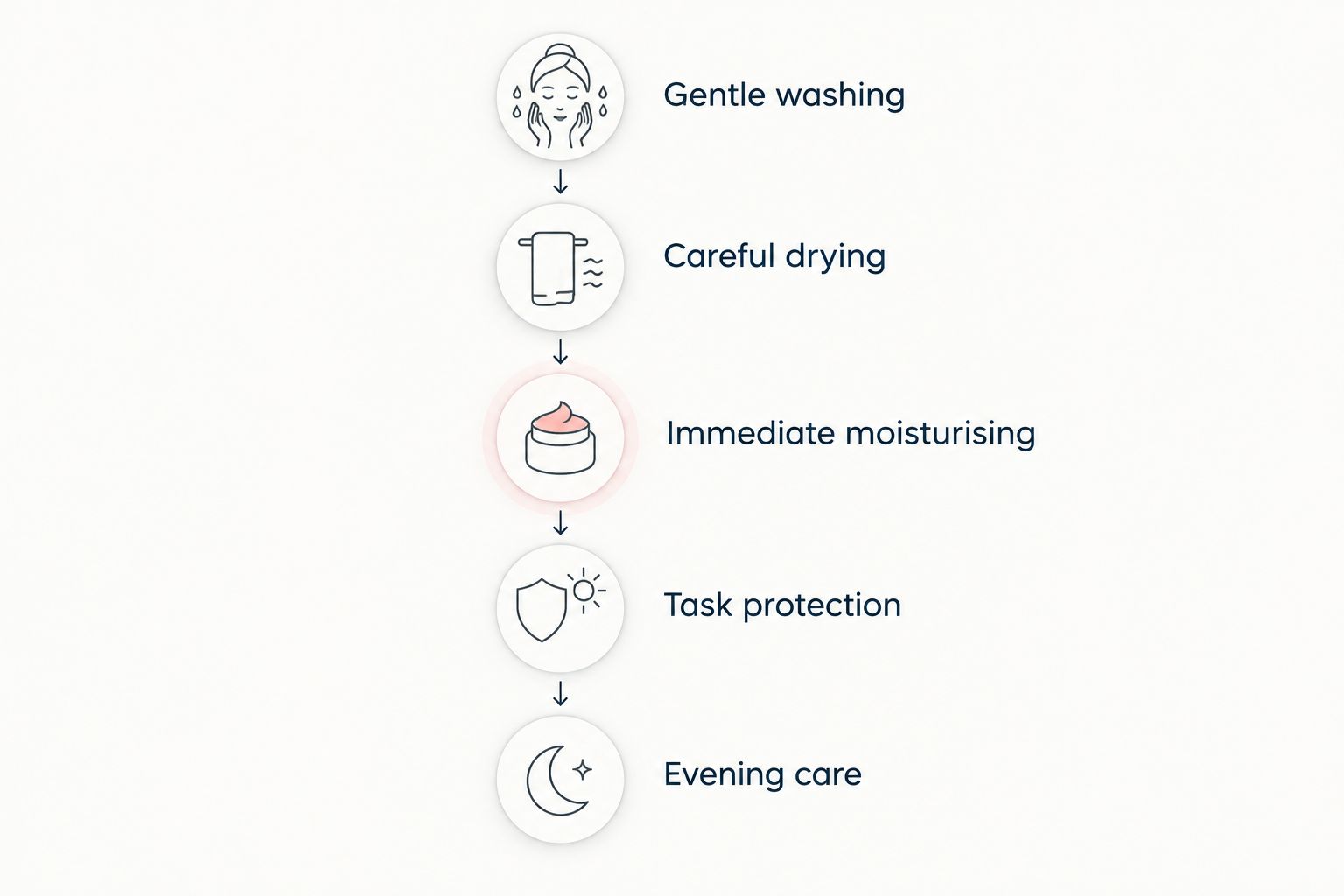
Make your hand-care routine match your day
Your routine should address what happens before and after moisturising. Buying a richer product does not cancel repeated irritation from washing or cleaning.
- Gentle washing: Use lukewarm water and a cleanser your skin tolerates. Avoid unnecessary scrubbing.
- Careful drying: Pat dry, including between the fingers, without rubbing sore areas.
- Immediate moisturising: Apply your chosen cream after washing, while the routine is still fresh in your mind.
- Task protection: Use suitable gloves for cleaning and other irritant exposure.
- Evening care: Choose a richer cream or ointment when daytime texture restrictions no longer matter.
These steps make product choice useful. A tube left in a drawer cannot support the routine as effectively as one placed beside the sink.
Which hand-care option should you choose?
Choose a fragrance-free cream if you are undecided. Add petrolatum at night when you need more occlusive protection, or choose a urea formula when intact skin feels rough rather than inflamed.
For your 2026 routine, avoid changing several products at once. Keeping the rest of your routine consistent makes it easier to identify which new product your skin tolerates.
If alpine natural skincare is your priority, Feuerstein Essentials belongs on your shortlist. For reactive hands, the deciding factor remains the individual formula, not the category story.
FAQ
What's the best hand cream for dry hands?
A fragrance-free hand cream is the best starting category for everyday dry hands. Choose a texture you will use after washing, and add a richer ointment overnight if needed.
What should I choose when searching for handcreme trockene hände?
Start with a fragrance-free cream and choose additional care according to your skin condition. Petrolatum suits overnight protection, while urea suits rough, intact skin rather than painful cracks.
Is hand lotion better than hand cream?
Hand lotion is not automatically better than hand cream. Lotions are generally lighter, while creams are generally richer; the complete formula and your skin's tolerance determine suitability.
Is natural hand care better for sensitive hands?
Natural hand care is not automatically better for sensitive hands. Botanical ingredients and fragrance can cause reactions, so assess the ingredient list rather than relying on natural-origin claims.
Can I use urea cream on cracked hands?
Urea can sting cracked or inflamed hands, so it is not the default choice for painful fissures. Use a bland moisturiser and seek advice if cracks persist, bleed, or show signs of infection.
Does dermatologically tested mean a hand cream is allergy-free?
Dermatologically tested does not mean allergy-free. The claim does not guarantee that every user will tolerate the formula or that the product is suitable for eczema.
When should I see a doctor about dry hands?
Seek medical advice when dryness comes with persistent itching, inflammation, recurrent cracks, or suspected infection. Moisturising supports skin care but does not replace diagnosis and treatment of hand eczema or contact allergy.
One last thing
Do not exfoliate cracked hands to remove roughness. Rough skin and damaged skin need different decisions; scrubbing an irritated area adds another exposure instead of solving the cause.
The best hand-care purchase in 2026 is the one that fits your skin and gets used after washing. Keep the routine simple before adding another active ingredient.


